

On August 18th, the Trade and Investment Promotion Support Center under the Vietnam Trade Promotion Agency (Ministry of Industry and Trade) organized a seminar (combining in-person and online participation) on developing import-export business with the US market. The event was themed: “Seizing Opportunities – Complying with Regulations – Promoting Balanced and Sustainable Trade”. The Can Tho Promotion Agency participated online.
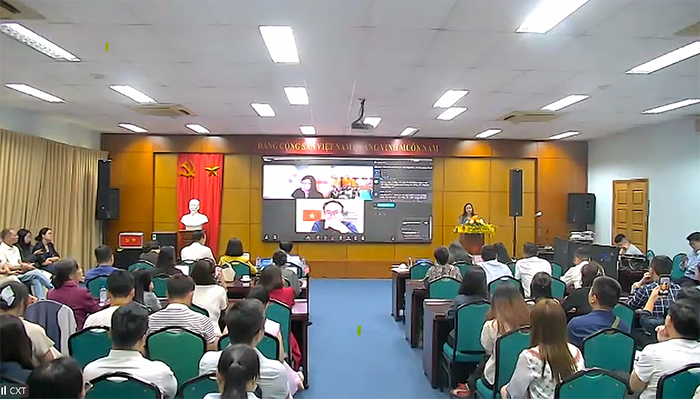
Seminar overview. Screenshot
In his opening remarks, Mr. Le Hoang Tai, Deputy Director of the Vietnam Trade Promotion Agency, emphasized that the US is one of Vietnam’s most important export markets, characterized by its large scale, high purchasing power, diverse distribution systems, and varied consumer demand. However, it is a highly competitive market with strict requirements regarding quality, traceability, labeling, environmental standards, labor practices, and intellectual property rights.
According to Mr. Le Hoang Tai, Vietnamese enterprises need to increase value-added content, diversify products, and boost imports of machinery, technology, raw materials, products, and services from the US. Mr. Tai stressed: “Regulatory compliance must be regarded as a core element of competitiveness”.
Alongside export activities, increasing imports of machinery and core technologies from the US serves as a practical solution to enhance domestic production capacity and move towards a harmonious, sustainable trade balance.
Data provided by Mr. Do Ngoc Hung, Head of the Vietnam Trade Office in the US, indicates that 2026 will mark the 25th anniversary of the implementation of the Vietnam-US Trade Agreement and more than three years since the establishment of the Comprehensive Strategic Partnership. Two-way trade turnover surged, reaching nearly $209.5 billion in 2025 and approximately $132.4 billion in the first half of 2026, making Vietnam the United States’ fifth-largest trading partner. However, exports remain heavily reliant on the FDI sector, while domestic enterprises account for a small share; this highlights an urgent need to increase localization rates and enhance the ability to participate directly in international distribution chains.
Identifying technical barriers and legal compliance requirements
Beyond the vast consumer potential of the U.S. market with a population exceeding 335 million, U.S. authorities are tightening regulations regarding economic security, rules of origin, and trade remedies. Mr. Do Ngoc Hung noted that businesses must closely monitor Section 301 investigations, regulations concerning forced labor which could trigger additional tariffs of up to 25%, and supply chain control requirements. Shipment-specific origin documentation and production data need to be digitized and systematically prepared from the outset to meet verification demands from U.S. Customs and Border Protection (CBP).

Goods exported to the U.S. face rigorous inspections regarding origin and supply chain security by local customs authorities. Photo: U.S. Customs and Border Protection (CBP)
Providing an in-depth analysis of financial and legal aspects, Ms. Dinh Dieu Linh, CEO of SzBCPA Tax Consulting in the U.S., stated that many exporters face pressure from payment cycles extending between 60 and 120 days, alongside various hidden costs. Notably, US tax authorities may impose a 30% withholding tax on revenue payable to the Internal Revenue Service (IRS) if contract documentation is deficient, while major states are intensifying sales tax collection efforts. Individuals or entities holding a 25% or greater stake in a US business are required to file Form 5472 to avoid financial penalties. Businesses can utilize tools such as bank-based document discounting, trade credit insurance, and currency forward contracts, or establish a US legal entity to facilitate participation in large-scale tenders.
Solutions for strengthening internal capabilities and expanding supply chains
Speaking at the seminar, Mr. Vu Tu Thanh, Regional Deputy Managing Director of the US-ASEAN Business Council, announced that the US Food and Drug Administration (FDA) plans to open a regional office in Hanoi to provide direct support for quality control and certification processes regarding food, agricultural products, and pharmaceuticals. In the technology sector, standards set by the US National Defense Authorization Act are creating opportunities for Vietnamese enterprises in high-tech industries, such as unmanned systems and supporting components.
Regarding machinery imports, Ms. Ann Ha, CEO of Defenova Global Connect LLC, identified US-sourced semiconductors, mechanical equipment, aerospace technology, and high-tech agricultural machinery as key resources enabling Vietnamese businesses to narrow productivity gaps and facilitate technology transfer.
Experts agreed that to successfully penetrate the US market, Vietnamese enterprises must proactively conduct market research, participate in B2B matchmaking events, manage finances effectively, verify product origins, control supply chains, and ensure legal compliance. The seminar emphasized the necessity of proactivity, transparency, and professionalism. This is a platform that helps businesses expand exports, strengthen their market position, and foster the sustainable development of bilateral trade between Vietnam and the United States.
Ngoc Thao